
There's a very common feeling in many companies: that of always explaining the same thing. To new employees, to suppliers, to collaborators, to clients. The same basics, the same processes, the same internal rules. Over and over again. The people change, but the discourse is repeated. And in that loop, time, consistency, and often clarity are lost.
The video tutorial appears right there, not as a single resource, but as a strategic tool. A way to record how a company works, what it expects from those who work with it, and how it wants things to be done. Not as a dry manual, but as living, visual, and easy-to-consume content. Because explaining well once is much more effective than explaining poorly a hundred times.
A good video tutorial doesn't just convey information. It conveys culture. It sets the tone, organises processes, and reduces errors. It's useful for training, but also for alignment. So that everyone starts from the same point, even if they arrive at different times.
Its potential is enormous, and yet it remains underutilised. Many companies see it as an afterthought, when in reality it can become one of the most valuable assets in your internal and external communication.
One of the great successes of the video tutorial is that It makes no excuses to the viewer. It doesn't depend on schedules, doesn't require a physical presence, and can be reviewed as many times as needed. Each person progresses at their own pace, goes back, pauses, and resumes. That, in training, is golden.
Furthermore, it allows something that is usually unachievable in day-to-day in-person interactions: key company profiles can participate. The CEO explaining vision and values. The HR manager setting internal guidelines. The technical team detailing complex processes. People whose time is limited, but whose message is fundamental. Video makes it possible for this information to be always available, without saturating schedules or relying on endless meetings.
However, not anything goes. A video tutorial cannot be an improvised chat in front of a camera. If done this way, the result is usually tedious, confusing, and ineffective. Just the opposite of what is sought.
The key lies in content control. In knowing exactly what you want to explain, in what order, and with what words. A script crafted with care, designed to be understood and remembered. Not to impress, but to clarify.
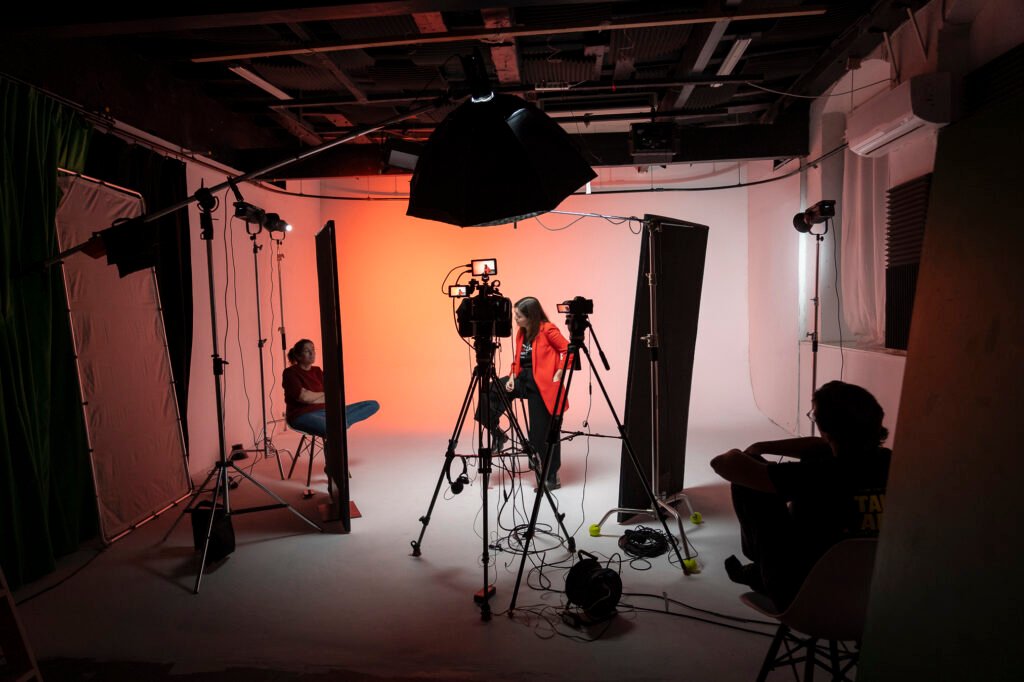
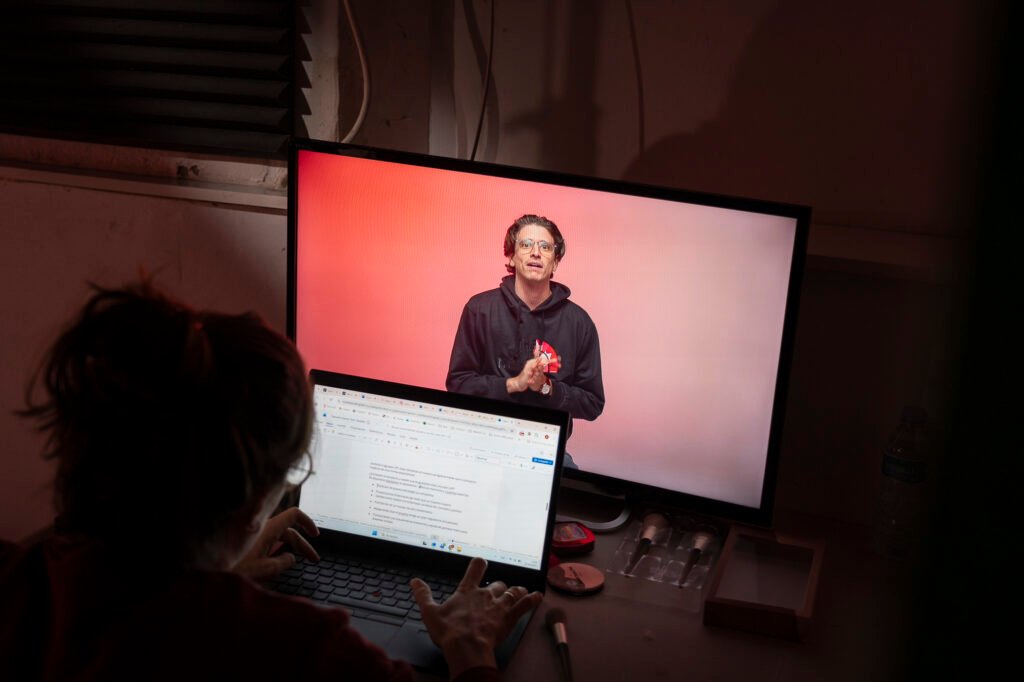
At RecTimePro, we approach it from there. We record people with teleprompter To ensure the message is fluid, natural, and precise. This eliminates unnecessary improvisation, filler words, and rambling. It allows the speaker to focus on communicating, not on remembering what comes next.
The teleprompter doesn't detract from naturalness, it protects it. Especially when the person appearing isn't used to speaking on camera. The result is a speech that's clear, calm, and coherent, conveying confidence and professionalism.
Layers can be added to this solid core. Motion graphics to reinforce ideas, visual diagrams to aid understanding of processes, on-screen text to accompany without overwhelming. All designed to make the content more engaging, clearer, and easier to follow.
It's not about embellishing. It's about help to understand.
Video tutorials work particularly well in many contexts: new employee onboarding, internal training, safety protocols, tool usage, service explanations, supplier relations, customer service. Any situation where repetition is constant is a clear opportunity for this format.
Furthermore, there is a less obvious but very real benefit: consistency. When information is centralised in well-structured videos, the message does not get distorted. It doesn't depend on who explains it that day or how they interpret it. It's the same for everyone. And that, in companies that are growing or that work with many different profiles, makes a huge difference.
Creating video tutorials isn't Record for the sake of recording. It's about thinking in the medium and long term. It's investing time once to save time later. It's organising knowledge and making it accessible. It's professionalising something that would otherwise end up chaotic.
When they are well made, video tutorials don’t feel like mandatory training. They feel like a help. Like a tool created to make the job of the person watching them easier. And that's where their true value lies. Not in the video itself, but in everything it prevents, organises, and improves from that moment on.
Stopping always explaining the same thing isn't stepping away. It's doing it better.
